
Curating pre-prompt context at scale within agentic workflows
TL;DR Summary (click to expand)
AI models are probabilistic, not deterministic. Ask the same question twice, or ask two different models the same question, and you’ll get two different answers, in two different tones, formatted two different ways. That’s a real problem when you’re trying to build repeatable, scalable agentic workflows for things like brand voice, client reporting, or design standards.
Skills within StationOne, a multi-LLM AI orchestration platform, solve for this. A skill is a pre-prompt template: a saved, reusable set of instructions, standards, and context that automatically gets applied every time a workflow runs, regardless of which model is doing the work or which team member is asking. Skills are how you turn tribal knowledge and one-off instructions into a durable standard your whole team, and every agent you build, can rely on.
When teams start experimenting with agentic AI, the conversation almost always centers on capability: Can it do the task? Can it connect to my tools? Can it save me time?
These questions are the right starting point. However, once a workflow moves from “interesting experiment” to “something my team relies on every week,” a different question becomes far more important:
Will it do the task the same way every time?
This is where agentic AI initiatives can quietly stall. Not because the AI can’t do the work, but because the output is inconsistent. One week’s report is formatted differently than the last. One piece of copy sounds on-brand; another reads like it was written by someone who’s never seen your style guide. A design asset uses the wrong shade of blue. None of these are catastrophic failures in and of themselves. But collectively, they erode trust and create exactly the kind of manual cleanup work automation was supposed to eliminate.
Why This Happens: AI Is Probabilistic, Not Deterministic
 At a technical level, large language models (LLMs) are probabilistic systems. Given the same prompt, a model doesn’t retrieve a fixed, pre-written answer. It generates the most statistically likely response based on its training, and the response can vary from run to run, even with identical input.
Layer on top of that the fact that different models, from different providers, have genuinely different strengths. Some are tuned to excel at creative, generative tasks like writing and ideation. Others are tuned toward more deterministic, analytical, or mathematical work. If your workflow uses one model this month and a different one next month, you introduce yet another variable that can impact consistency.
Even with a single model, the way a request is phrased greatly influences the result. If your team is manually retyping brand guidelines, formatting requirements, or approved terminology into a prompt every time someone runs a workflow, you’ve introduced a human bottleneck and an error rate right back into the process you were trying to automate.
The result: Consistency and continuity, in messaging, brand voice, formatting, and the specific standards your organization cares about, becomes one of the hardest problems to solve as teams scale their use of agentic AI.
The Fix: Build Standards Into the Harness
Many teams attempt to solve the problem with better prompting discipline: Write a really good prompt, save it in a doc somewhere, ask everyone to copy and paste it each time. In practice, this doesn’t scale. Prompts get shortened. Standards get forgotten. New team members don’t know the doc exists, and every model swap means retesting the same instructions all over again.
This is exactly the kind of problem an AI harness such as StationOne is built to solve. StationOne sits above any individual model, orchestrating your AI model, MCP connectors, knowledge base, and workflows in one governed environment. It can contextualize every request to standards you define once, rather than requiring you to reintroduce them every time.
This capability is what we call a Skill.
What Is a Skill?
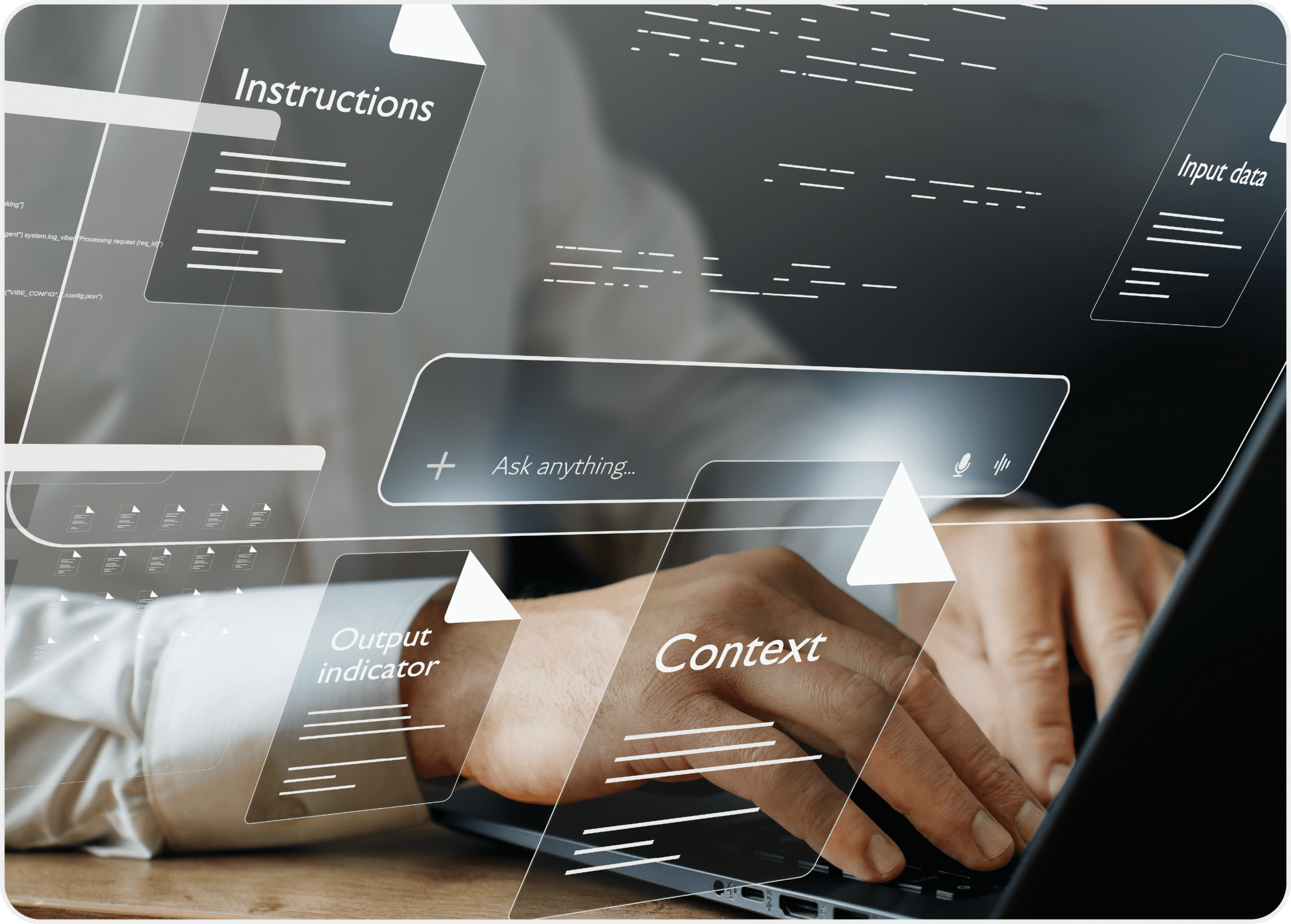
A skill is a pre-prompt template: a saved, reusable set of instructions, context, or constraints automatically applied whenever it’s invoked, whether that’s inside a chat conversation, an autonomous agent, a structured playbook, or another workflow. Instead of typing your brand voice guidelines, formatting requirements, or approved standards every time you need AI to do something, you build the context into a skill once. From that point forward, every relevant output automatically inherits it.
This allows consistency to scale independently of who’s building the workflow, which model is powering it, or how the request happens to be phrased that day.
Skills in Action: Use Cases
1. Brand Voice
Every organization has a point of view on tone: how formal or casual to be, which words to use (and which to avoid), how to talk about the product, how to handle sensitive topics. A brand voice skill encodes your dos and don’ts once: tone, terminology, sentence structure preferences, and what to avoid. From then on, any content a workflow generates, whether it’s a blog post, a client email, or ad copy, reads consistently, regardless of who on the team kicked off the workflow or which model runs underneath it.
Workspace Settings: Writing Style
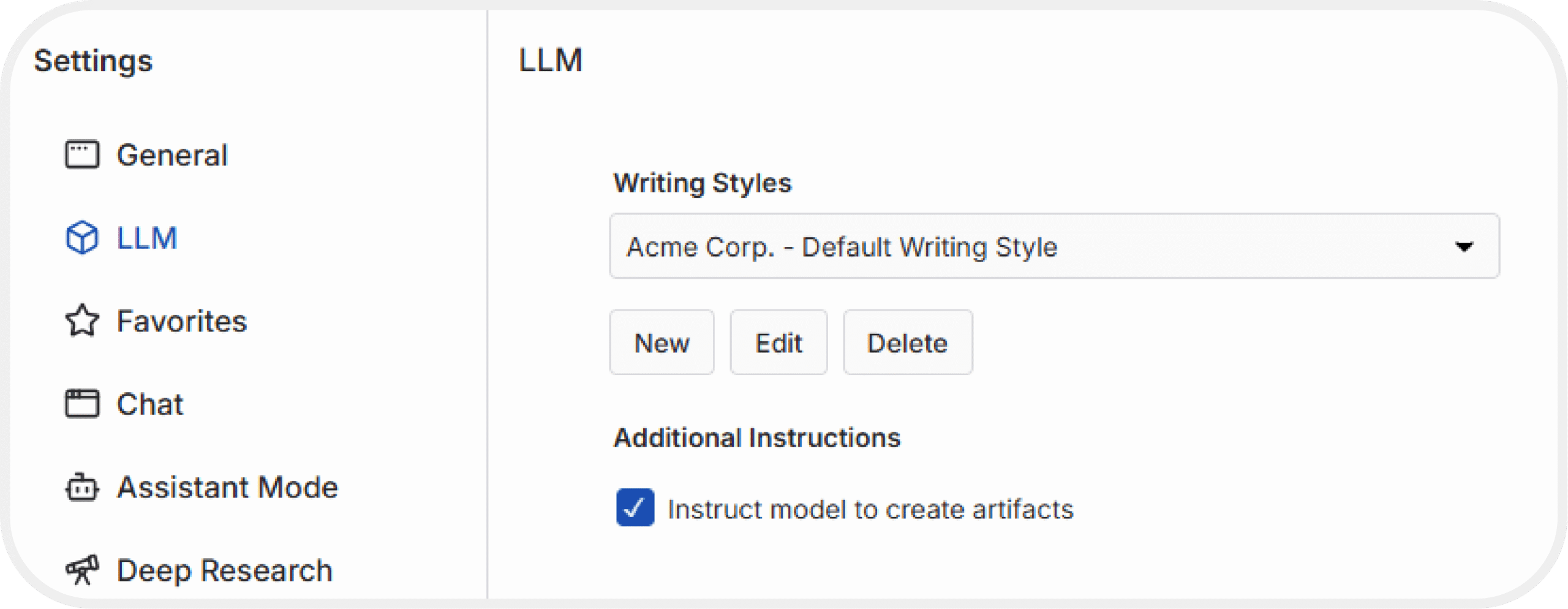
If you want writing voice locked in at a broader level, StationOne offers Writing Style as a native, built-in feature at the workspace level. Rather than (or alongside) building a dedicated skill, you can set a hard-coded writing voice directly in your workspace settings. A brand voice skill gives you more granular control for specific use cases, but workspace-level Writing Style is a fast, native option when you want one consistent voice applied broadly across everything in a workspace.
2. Brand Identity & Design Standards
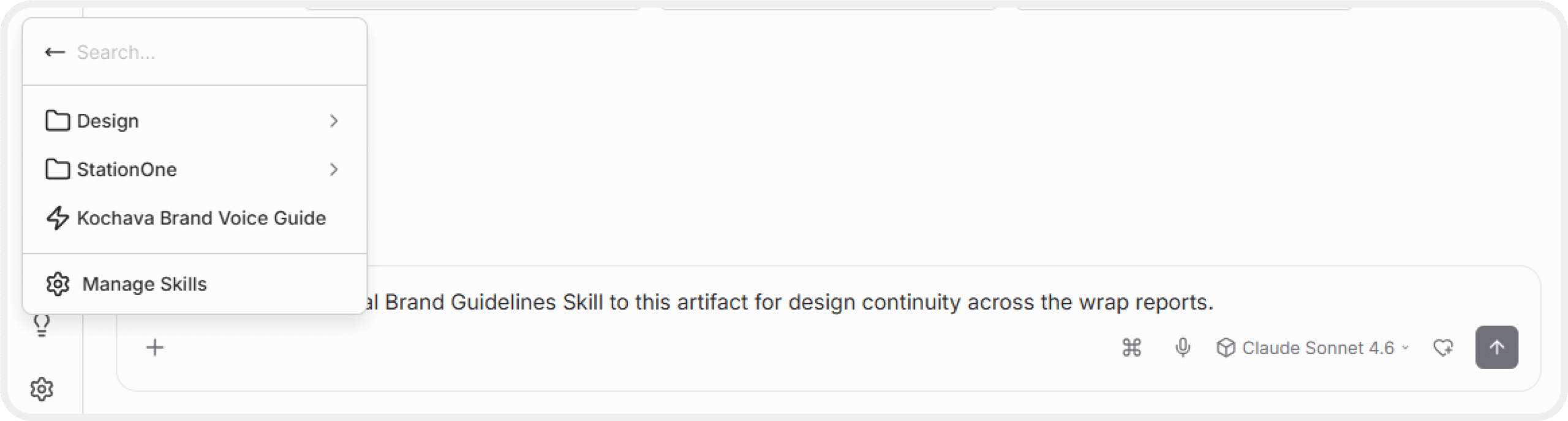
Consistency isn’t limited to words. Teams use AI to help design assets from socials to one-pagers to presentations. Brand standards are as important to visual output as they are to written copy, and there’s no room for “good enough.” A design-focused skill can specify approved colors, approved fonts, logo files and usage rules, padding and spacing conventions, and layout preferences. Once this is built into a skill, every asset generated through that workflow reflects your brand standards by default, instead of relying on someone remembering (or re-explaining) the brand guidelines every single time.
3. Standardized Reporting & Analysis
 Skills are equally powerful for structuring how AI returns information and results, particularly for recurring analysis and reporting. Take the Atlas Performance workspace built for publishers as an example. Publishers frequently need to generate a recurring “wrap report” summarizing performance for a given period. A reporting skill can specify exactly what belongs in the report: which KPIs and metrics to include (and what to call them, so terminology stays consistent over all reports), which charts and graphs to generate, and how data should be visualized and displayed. Once the skill is built, every auto-generated wrap report follows the same standard, whether it’s built by a different team member, run on a different day, or powered by a different underlying model.
4. Legal, Compliance & Technical Standards
The same logic applies well beyond marketing and design. A compliance-focused skill can instruct AI to flag language that may conflict with regulatory requirements, internal policy, or contractual language before anything is finalized. A technical documentation skill can enforce formatting conventions and terminology standards for product or developer-facing content. Any place where compliance and standards are required is a candidate for a skill.
The Human in the Loop Still Matters
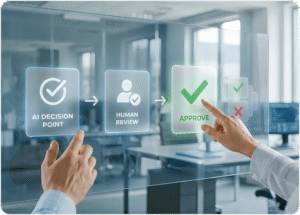 None of this replaces human judgment, and it isn’t meant to. Human review checkpoints and a last-mile review before publishing or delivery to a client is more vital than ever. Skills change how much and what type of work human team members focus on.
Instead of starting from scratch and checking for brand voice, formatting, approved terminology, and structural standards, a reviewer is checking work that already reflects these standards by default. In practice, this can reduce the last-mile review to a fraction of what manual review would otherwise require, in some cases cutting remaining work by as much as 95%. AI handles the repeatable, standards-based first draft. Humans handle judgment, nuance, and final sign-off.
Building Your AI Skills Library
Skills compound in value as your use of agentic AI grows. Every new agentic workflow you build can draw on the same library of standards you’ve already established, rather than starting from zero. A well-built skills library becomes a durable asset: the accumulated standards of your organization, encoded once and applied consistently, no matter which model you’re using or who on your team is doing the building.
Skills are also to be shared. StationOne includes a growing public gallery of skills, available to browse and adopt without having to build a given standard from scratch.
Within your own organization, individuals or entire departments can build skills, then publish them for the broader team to use. A skill built once by one person, whether it’s a brand voice standard, reporting format, or design specification, doesn’t have to stay siloed with its creator. It can be shared and reused org-wide, making skills not just a consistency tool, but a genuinely scalable one.
If consistency and continuity are the sticking point standing between your team and confident, scaled use of agentic AI, contact us to explore how skills within StationOne can help.
Ready to Build Your First Skill?
StationOne makes it simple to define a skill once and apply it everywhere no matter which AI model is doing the work.
Download StationOne to get started.
Agentic AI Skills FAQ
What is a skill in agentic AI, and how is it different from a prompt?
A skill is a reusable, prebuilt set of instructions and standards, such as brand voice rules, approved colors, or reporting formats, that automatically applies to every relevant AI request. Unlike a one-time prompt, which has to be rewritten or re-explained each time, a skill is saved once and consistently applied across every future chat, agent, or playbook that uses it.
Why do AI outputs vary even when using the same prompt?
LLMs are probabilistic, not deterministic, so the same prompt can produce slightly different outputs each time, and different models are naturally better suited to different types of tasks (creative vs. analytical, for example). Skills reduce this variability by encoding fixed standards and context that apply regardless of which model generates the output.
Do skills eliminate the need for human review of AI-generated content?
No. Skills reduce the amount of manual correction needed, in some cases by as much as 95%, by ensuring outputs follow brand and formatting standards. However, a final human review is still recommended before publishing or distributing any AI-generated work.