
Your Biggest Projects Just Met Their Match
StationOne Playbooks—Your AI Sandbox for Complex, Multistep Initiatives
See Playbooks live and in action. Contact us for a demo.
StationOne Playbooks—Your AI Sandbox for Complex, Multistep Initiatives
See Playbooks live and in action. Contact us for a demo.


Playbooks aren’t just better prompts—they’re the level-up from one-off AI chats to persistent, project-based intelligence. Think of them as your personal sandbox where complex initiatives come together: research, deliverables, collaboration, and execution—all in one place, powered by AI that remembers, evolves, and delivers.
The result?
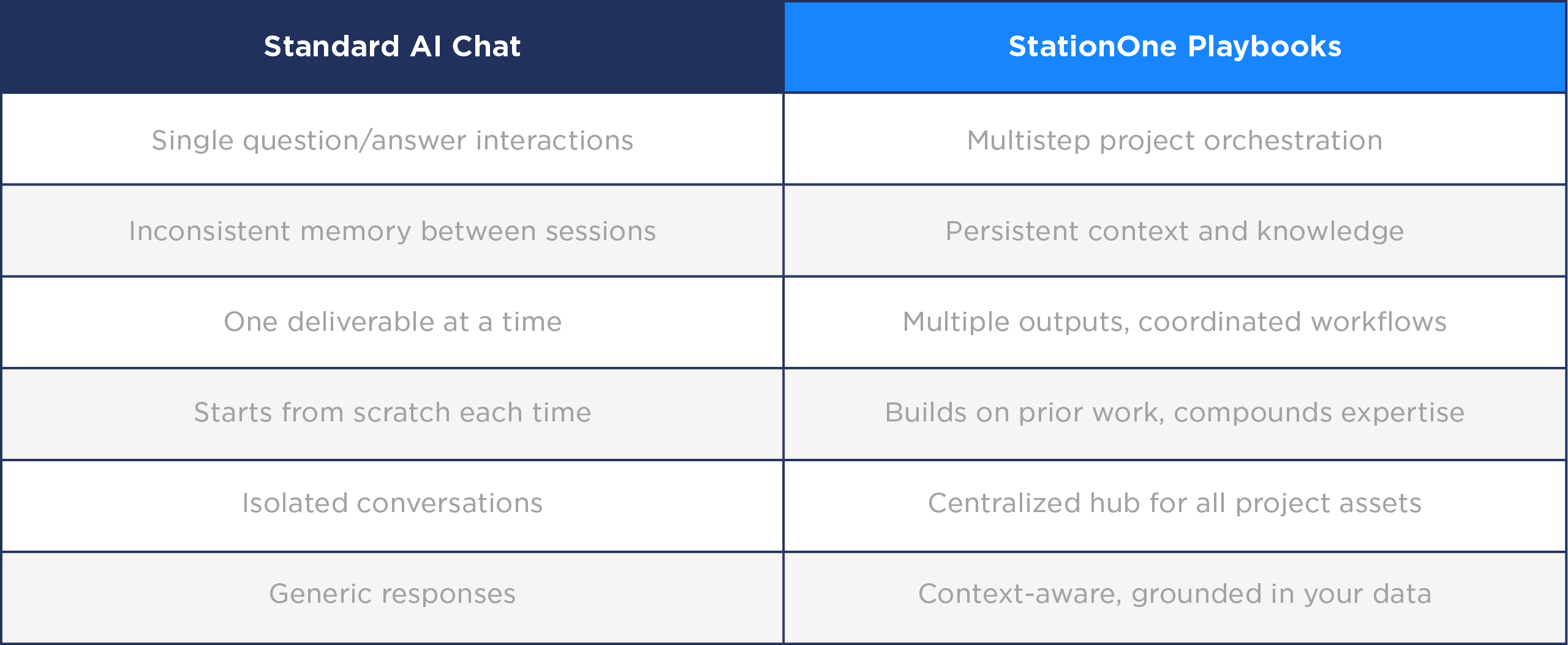
Think of Playbooks as the conductor of your operation—harmonizing research, execution, deliverables, and iteration so every element is in sync for your projects to achieve flawless performance.

Ready to level up with Playbooks? Contact us for a demo.
Challenge
Plan $2M Q2 budget across 12 channels with audience targeting, forecasts, and executive recommendations—all under tight deadlines.
Playbook Flow
Result
2 weeks → 3 hours, one workspace, no lost context
Challenge
Deliver comprehensive 12-month growth strategy including market analysis, channel recs, creative framework, measurement plan, and quarterly roadmap.
Playbook Flow
Result
Weeks of workshops and revisions → half the time, coordinated in one workspace
Challenge
Update company handbook quarterly for policy changes, legal compliance, benefits updates—while maintaining consistency across versions.
Playbook Flow
Result
No more Word doc chaos; one workspace where every iteration evolves with full context
Challenge
Analyze customer behavior across six product lines, identify growth opportunities, deliver exec-ready insights with visualizations and recommendations.
Playbook Flow
Result
Days of juggling queries and decks → hours in one workspace with single source of truth
One-Click Creation
Start with a prompt. Watch Playbooks build the structure, suggest workflows, and set up your project framework.
Smart Knowledge Storage
Drop in files, transcripts, case studies, and data. Retrieve them instantly when needed. Your playbook becomes your project’s single source of truth.
Automated Process Execution
Set up recurring workflows—weekly reports, monthly analyses, quarterly reviews—that run hands-free.
Custom Skills & Auto-Suggestions
Playbooks learn from your work and suggest new skills (shortcuts, templates, automations) as you go.
Integrates With Your Tools
Connect to Slack, Asana, email, calendar, Google Drive, CRM, analytics platforms, and more. Playbooks work where you work.
Shareable Templates
Anyone can package and share their playbooks, so inspiration is just one click away. Build a library of proven workflows.
Personal or Team Playbooks
Keep your own private drafts or work together across teams and departments—your choice.

Chat: “Write me a campaign brief.”
Playbooks: Execute an entire go-to-market strategy—from competitive research to campaign briefs to creative QA to launch tracking—all in one place.
Standard AI chat is tactical. Playbooks are strategic.
With Playbooks, you’re not just getting answers—you’re orchestrating complex projects with multiple deliverables, dependencies, and stakeholders. You’re building a knowledge system that gets smarter with every project you run.
Start with a simple prompt that describes your project or goal:
No coding required. If you can describe what you need, Playbooks can build it.
Bring in everything your playbook needs to be effective:
Upload files: PDFs, spreadsheets, presentations, research docs, transcripts
Connect tools: Pull live data from Asana, Slack, Google Drive, CRM, analytics platforms
Store references: Case studies, brand guidelines, past projects, competitive intel
Capture conversations: Transcripts from meetings, Slack threads, stakeholder input
Your playbook becomes a living knowledge repository that understands your context, remembers your preferences, and retrieves the right information when you need it.
Playbooks aren’t just for answering questions—they orchestrate complex workflows with multiple outputs and dependencies. For example:
Each step builds on the previous one. Context is preserved. Nothing is lost between tasks.
Playbooks evolve with your project. Edit, refine, and improve conversationally:
No digging through files. No version chaos. Just ask, and your playbooks update accordingly.
Turn your playbook into a reusable template for future projects:
Ask about team collaboration features for real-time coworking inside Playbooks.
Whether you’re a solo professional or leading a team, Playbooks adapt to your needs:
Plan, execute, and track multichannel campaigns from one workspace.
Automate intake, discovery, strategy development, and kickoff deliverables.
Pull data, generate insights, build presentations—all on schedule.
Manage editorial calendars, brief creation, content QA, and publishing workflows.
Store knowledge, auto-fill responses, maintain brand consistency.
Coordinate research, messaging, creative, go-to-market plans, and launch tracking.
Build repeatable programs with schedules, resources, and check-ins.
Upload data, run analyses, generate executive summaries—iteratively.
Maintain handbooks, policies, and audit trails with version control.
Organize projects, track goals, store research, and automate recurring tasks.
Pro Tip: The best playbooks are built by the people closest to the work. Start simple, iterate often, collaborate with your team, and watch your playbook evolve into an indispensable command center for your most complex projects.
No! StationOne Playbooks are designed for business users and professionals of all backgrounds. If you can type a sentence, you can build a playbook. No code. No technical skills required.
Absolutely. Playbooks integrate with Slack, Asana, email, Google Drive, calendars, analytics platforms, CRMs, and more. We’re always adding new connectors based on your feedback.
Yes. Package any playbook as a reusable template. Share it with your team or the StationOne community.
Playbooks are grounded in your knowledge—files, guidelines, past work, and data you upload. Every output cites sources and follows your instructions. You can also set brand voice guidelines so a playbook matches your tone and style consistently.
That’s what they’re built for. Playbooks excel at multistep, multi-deliverable initiatives with dependencies, iterations, and coordination needs. The more complex your project, the more your playbook shines.
Just ask conversationally. “Update the budget section.” “Add a competitive analysis.” “Revise the messaging framework.” Playbooks adapt in real time without breaking your workflow.
Ready to build your first playbook?
Try StationOne Playbooks and see how easy it is to automate, capture, and accelerate your most important work.