
Building the future of agentic advertising in StationOne
TL;DR Summary
StationOne by Kochava is a game-changer for advertising, built on smart AI principles that make your workflows reliable and easy to check. It avoids confusion by connecting directly to the tools you need and making each AI task simple and focused. This approach ensures that your agentic automation is trustworthy, scalable, and easy to manage. StationOne uses a mix of AI models for balanced recommendations and is designed to be updated easily as technology or rules change. It’s a transparent and future-proof way to automate your advertising, making your team more productive and competitive. Explore agentic possibilities in StationOne by visiting StationOne.ai/request-invite/.
Innovation has always been at the core of Kochava. As we move rapidly into an AI-first era, the lessons from production-grade agentic AI are not just theoretical, they’re foundational. This recent white paper on agentic AI best practices aligns closely with the philosophy behind the approaches we use within StationOne. While we didn’t collaborate on common concepts, StationOne is a perfect implementation of the approaches advocated in the white paper.
StationOne typifies these best practices in the various features of the toolset including within Agent Forge. If you aren’t part of the beta, I encourage you to sign up for an account. It’s free, and we’re involving our partners and customers to give them an Integrative AI view on their workflows.
9 Agentic AI Best Practices
1. Prioritize Direct Tool Calls Over Monolithic Model Context Protocol (MCP) Inference
Agentic AI flourishes when external systems and APIs are accessed directly, without unnecessary abstraction across broad-based MCP connectors. Many vendors are building their MCP connectors with 20, 30, 40, or even 80 tools. If you are calling these MCP connectors broadly, your inference engine will likely get confused. With StationOne, we have not only built a broad-based, curated gallery of MCP connectors, but we also provide easy-to-use UI capabilities to selectively scope tool access from these connectors throughout the StationOne UI. This means that even if your vendor MCP has loads of tools, you can scope access to specific tools and keep things consistently delivering the outputs you expect. This is the case within the Conversations Facet as well as Agent Forge.
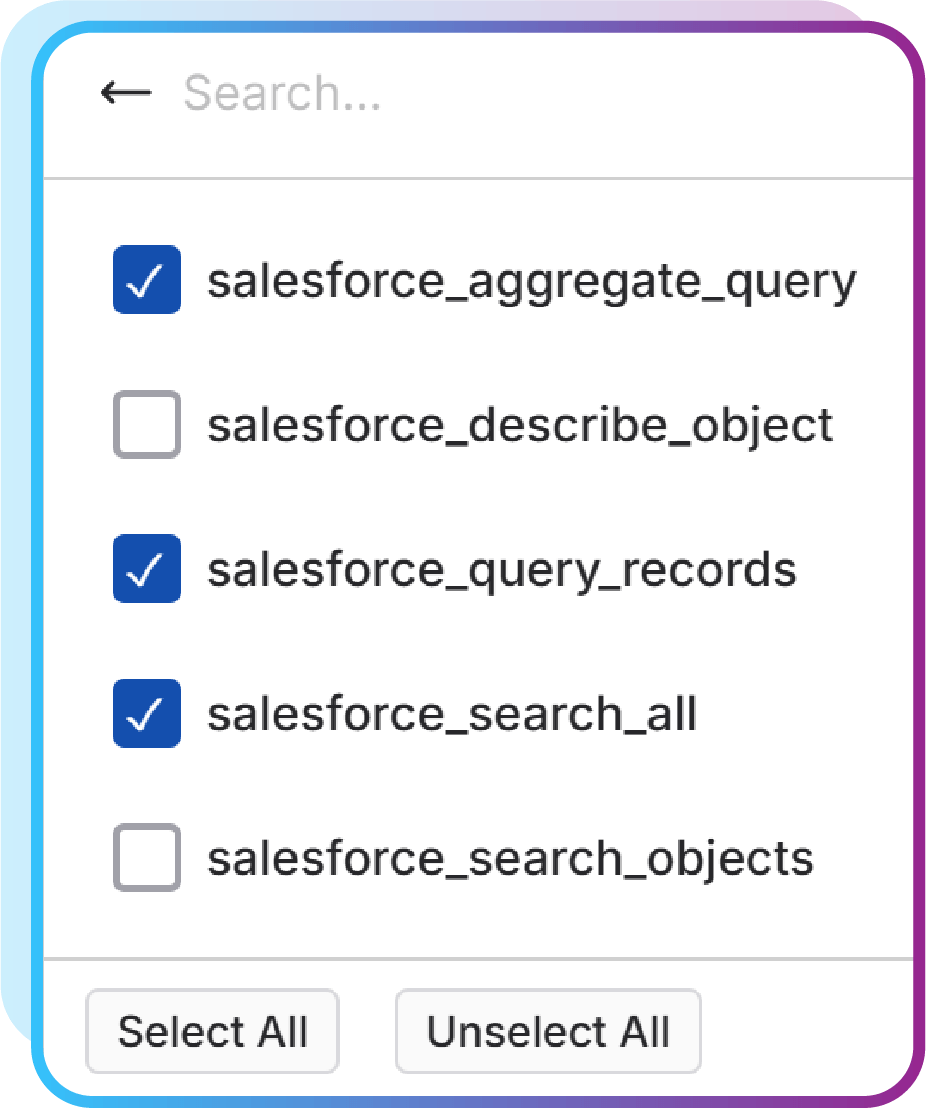
Example where the Conversations Facet enables access to specific tools within the Salesforce MCP connector within StationOne.
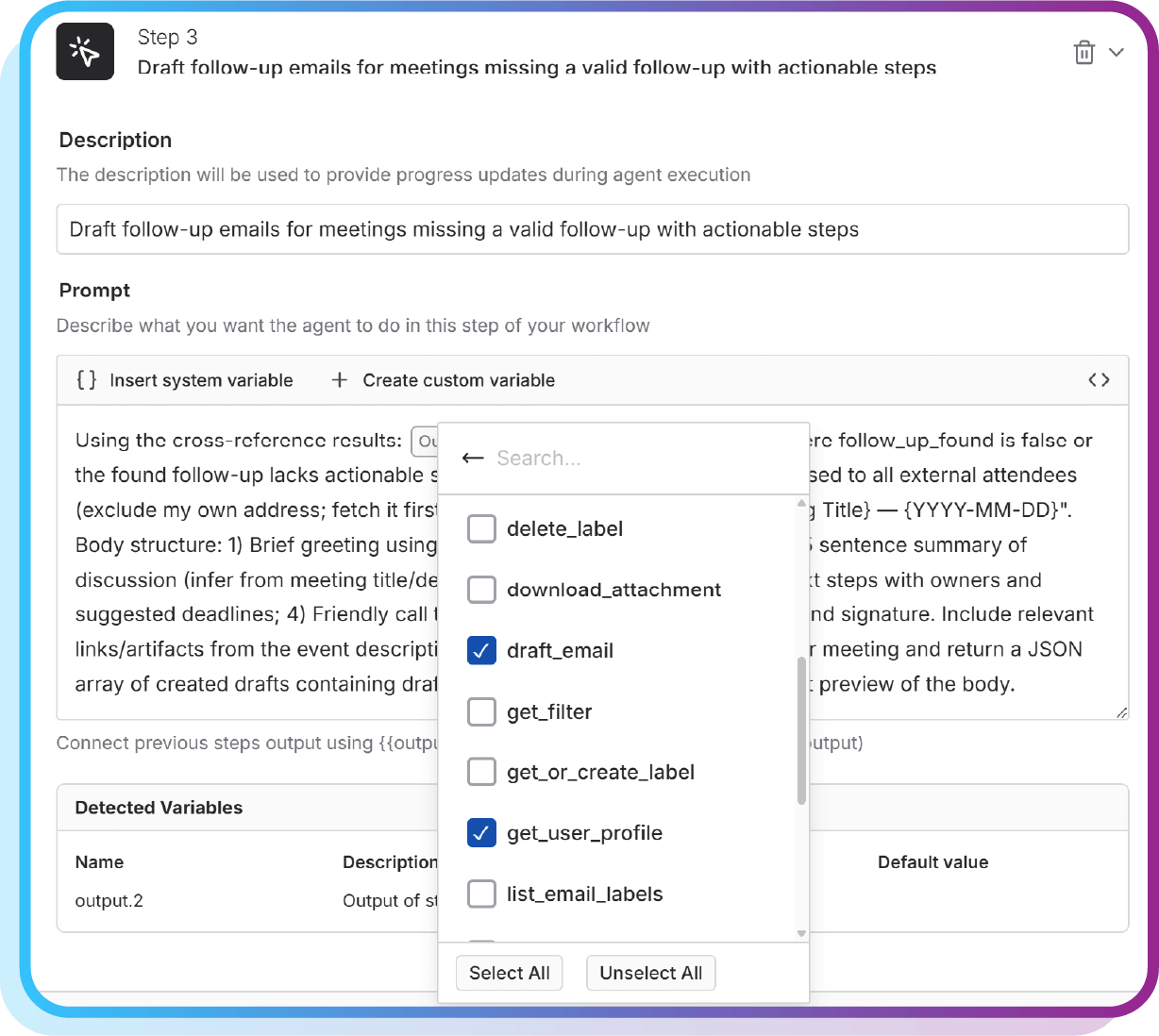
Agent Forge (the no-code agent builder in StationOne) also selectively applies tool calls to workflow steps to avoid LLM inference confusion.
Example in Advertising: When an ad operations manager pulls creative performance data by creative unit, the StationOne agent can call the reporting API directly for campaign data from measurement tools and creative performance data from DCO tools—ensuring that results are quick, unambiguous, unified, and auditable.
2. Favor Pure Function Calls in Orchestration
Using pure code for infrastructure tasks (such as executing a data export) keeps things deterministic and highly testable. The leverage of tooling within StationOne via the MCP connectors means that our orchestration layer in StationOne is reserved for code that operates with zero ambiguity—leaving natural language processing to the AI models.
Example in Advertising: Exporting log-level attribution data to a secure bucket is performed directly by an MCP connector (like the Kochava MMP MCP), sidestepping risky/ambiguous AI interpretation.
3. One Tool Per Agent
Agent Forge creates agents with distinct Agent Workflow Steps that have their own context and prompt instructions, and can pass context from one step to the next—with scoped access to MCP tools per step. This means that each StationOne agent workflow step is lean, modular, and single-purpose. We don’t overload one AI process with six subtly different jobs. This clean separation keeps each workflow simple—a must for debugging and scale.
Example in Advertising: The workflow for ad fraud detection uses one agent to fetch data, another to analyze patterns against the back-end fraud toolset, and a third to handle notifications or reporting conclusions, reducing errors and increasing clarity.
4. Single-Responsibility Agents
Each workflow step within StationOne agents is tuned to do one thing—and do it well. This aligns our development process with modern engineering: focused, testable, and easy to swap out or extend. This also serves enterprises that have traceability and governance requirements to adhere to.
Example in Advertising: An agent tasked solely with enforcing tracking URL consistency or attribution logic configuration alignment never doubles up as a data cleanup bot—ensuring focus and safety.
5. Externalize and Version Prompts
Prompts—the DNA of AI behavior—are stored as experts but can also be stored externally, versioned, and easily updated by domain experts without redeploying code via the StationOne server-side Knowledge Base RAG system. This means that our product, legal, and privacy teams can iterate governance and brand alignment without developer bottlenecks or code changes.
Example in Advertising: When privacy rules on data usage change, policy experts can update prompt instructions for data management agents without an engineering sprint.
6. Model Consortium and Responsible AI
We employ a model consortium (e.g., OpenAI, Gemini, Llama, Anthropic) and can optionally consolidate outputs in StationOne, reducing bias and catching inconsistencies. This has a direct benefit for advertisers who depend on trustworthy outcomes for campaign optimization and compliance.
Example in Advertising: Multiple models generate insights on campaign underperformance; a reasoning agent reconciles these views for a balanced recommendation.
7. Separate Workflow Logic from MCP Servers
We have abstracted MCP connectors from the core framework of StationOne. By decoupling the workflow engine from the communication interface (our MCP connector system), StationOne’s core logic is easier to update, scale, and operate over time—critical for a dynamic industry like advertising.
Example in Advertising: When a partner updates their API, we change the integration in a dedicated module—without overhauling the entire agent orchestration logic.
8. Containerized Deployment (Docker, Kubernetes)
StationOne is deployed on customers’ own devices (their laptop or desktop). This means that execution happens as an extension of the human to make the human more productive. It also means that deployment of agents is not in an anonymized cloud infrastructure—they’re running on your machine as you. This brings reliability, scalability, and seamless integration with both legacy and greenfield infrastructures at advertiser and agency clients.
Example in Advertising: New campaigns can be created or modified, tested, and scaled independently—without risk to core operations and as an extension to the ad ops team.
9. Keep It Simple, Stupid (KISS)
Agentic AI shouldn’t be mysterious; it should be transparent and straightforward under the hood. This makes onboarding, debugging, and innovating faster for our clients and partners.
Example in Advertising: Campaign workflow templates in StationOne are flat, file-based, and easily editable, avoiding deep nesting that confuses media planners.
Why Agentic AI Best Practices Matter
As advertising grows more interconnected and data-driven, the need for transparent, auditable, and agile automation increases. StationOne by Kochava is purpose-built with these agentic AI best practices at its foundation—making our clients more competitive and our infrastructure future-proof.
For those striving to stay ahead, it’s not about having more tools, it’s about making those tools Integrative with the AI capabilities available today. StationOne is a leader in Integrative AI because of these best practices.
To request a StationOne invite, visit StationOne.ai/request-invite/. StationOne is available as a downloadable AI client for Windows, Mac, and Linux.
Frequently Asked Questions (FAQ)
How can advertisers use agentic AI?
Advertisers can use agentic AI to automate complex, data-driven workflows, ensuring greater transparency, accuracy, and compliance. Specific use cases highlighted by StationOne’s approach include:
- Campaign reporting and auditing: Pulling creative performance data and campaign data directly from measurement and DCO tools for quick, unambiguous, and auditable results.
- Ad fraud detection: Using separate agents for different stages, such as fetching data, analyzing patterns against a fraud toolset, and handling notifications.
- Compliance and governance: Enforcing consistency in elements like tracking URLs and attribution logic, and updating agent behavior instantly based on new privacy rules by externalizing and versioning prompts.
- Optimization and recommendations: Employing multiple AI models (a model consortium) to generate and reconcile insights on campaign performance for a more balanced and trustworthy recommendation.
How can advertisers build AI agents to automate tasks?
Advertisers can build their own AI agents through StationOne’s Agent Forge, which is a no-code agent builder. The key to building effective, scalable agents is following best practices:
- Modular design: Create agents with distinct agent workflow steps where each step is lean, modular, and single-purpose (single-responsibility agents).
- Scoped access: Give each step its own context, prompt instructions, and scoped access to external tools (MCP connectors) to prevent the AI from getting confused.
- Focus AI: Reserve the AI models for natural language processing, and use pure function calls for deterministic, infrastructure tasks like data export.
What's the best AI platform for advertisers?
StationOne by Kochava is a leader in Integrative AI and is the platform that implements key agentic AI best practices. These are designed to ensure that the resulting automation is trustworthy, auditable, scalable, and future-proof. The platform is “purpose-built” with these foundations to make clients more competitive. StationOne is available as a downloadable AI client for Windows, Mac, and Linux.